Registration & Important Dates
Registration is FREE! Join us for three days of science, workshops, and networking at no cost.
Registration is open! Secure your spot by registering before the deadline.
Important Deadlines:
- Abstract Submission Deadline: April 20, 2026.
- General Registration Closes: April 20, 2026
- Vendor Registration Closes: April 1, 2026
*Details regarding poster size, set-up, judging criteria, and final award amounts will be provided soon.*
**Poster presentation is a graduation requirement for students in the NTP program, and awards will be given for best posters.**
Register Now — It’s Free! Abstract Submission Sponsor Registration
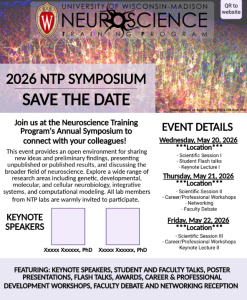
Symposium Flyer
Download or view the official symposium flyer for a quick overview of the event, dates, and locations.
Event App & Resources
Stay up-to-date with the latest schedule changes, speaker locations, and interactive features using our official event app and web portal.
Web App Portal
Access the symposium program, abstracts, and maps directly from any browser (desktop or mobile) without downloading an app.
Mobile App Download
For the full event experience, scan the code below to download the mobile app.
Schedule
A detailed program including all faculty and student talk titles will be provided soon.
| Time | Wednesday, May 20th | Thursday, May 21st | Friday, May 22nd |
|---|---|---|---|
| 7:30–9:00 | 7:30-8:00: Sponsor Space Opens 8:00–9:00: Registration / Check-in |
7:30-8:00: Sponsor Space Opens 8:00–9:00: Registration / Check-in |
7:30-8:00: Sponsor Space Opens 8:00–9:00:Registration / Check-in |
| 9:00–10:15 | 9:00–9:30: Welcome Remarks | 9:00–10:30: Industry Career Panel | 9:00–10:15: Academic Funding Session |
| 9:30–11:00 | Scientific Session I (Part 1): 9:30–10:40: Allison Barth, Jarrod Lewis-Peacock, & Student Talks 10:40–11:00: Coffee Break |
10:30–11:00: Coffee Break | 10:15–10:30: Coffee Break |
| 11:00–12:10 | Scientific Session I (Part 2): 11:00–12:10: Daniel Kerschensteiner, Lisa Monteggia, & Student Talk |
Scientific Session II: 11:00–12:10: Michael Michaelides, Cathyrn Cadwell, & Student Talks |
Scientific Session III (Part 1): 10:30–11:10: Student Talks 11:10–12:10: Keynote Lecture II – David Gamm |
| 12:00–1:30 | 12:10–1:30: Lunch | 12:10–1:30: Lunch | 12:10–1:30: Lunch |
| 1:30–3:30 | 1:30–2:00 Flash Talks 2:00–4:00 Poster Sessions and Sponsor Fair |
1:30–3:00: Science Communication Panel 3:00–3:30: Flash Talks |
Scientific Session III (Part 2): 1:30–2:20: Min Dong, Monika Jadi 2:20–3:00 Closing Ceremony and Awards |
| 3:30–5:00 | 4:00–5:00: Keynote Lecture – Richard Tsien | 3:30–5:30: Poster Sessions and Sponsor Fair | — |
| 5:00–7:15 | 5:00–6:00: Networking Social 6:15–7:15: Trivia |
5:30–6:30: Faculty Debate | — |
Keynotes & Invited Speakers
The complete program guide, including all speaker abstracts, locations, and presentation details, is available for download here.
Richard Tsien, PhD – NYU Langone
Time: Day 1, 4:00 PM
Location: First Floor Auditorium
Talk Title: [Title of Keynote Lecture I]
Bio: Richard Tsien is a world-renowned neurobiologist celebrated for his pioneering research on voltage-gated calcium channels and their critical role in neurotransmitter release and gene expression. His work elegantly bridges the gap between cellular biophysics and systemic neuroscience, particularly through his investigations into synaptic plasticity and the mechanisms underlying long-term potentiation.
A member of the National Academy of Sciences, Dr. Tsein’s extraordinary contributions have been recognized with the filed’s highest honors, including the Ralph W. Gerard Prize and Julius Axelrod Prize. Currently the Druckenmiller Professor of Neuroscience and founding director of the NYU Neuroscience Institute, his leadership and mentorship have been instrumental in shaping the global landscape of modern molecular neuroscience.
David Gamm, MD, PhD – University of Wisconsin – Madison
Time: Day 3, 11:10 AM
Location: First Floor Auditorium
Talk Title: [Title of Keynote Lecture II]
Bio: David Gamm is a leading figure in the field of regenerative ophthalmology, dedicated to reversing the effects of incurable vision loss. As a practicing pediatric ophthalmologist at the University of Wisconsin and a principal investigator at the Waisman Center, Dr. Gamm bridges the gap between clinical care and cutting-edge laboratory science.
His research focuses on inherited and acquired retinal degenerative diseases, such as retinitis pigmentosa and age-related macular degeneration. By leveraging human stem cell technology his lab successfully mimics human retinal development to uncover the cellular “checkpoints” required to grow healthy retinal tissue.
Session Speaker Roster: Thematic Divisions
The remaining speakers and poster presenters are organized by the following research areas:
Cellular, Molecular, & Development
Focuses on basic mechanisms of cell function, genetics, and early development.
Min Dong, PhD – Harvard University
Title of Talk
Min Dong leads a research laboratory focused on uncovering the molecular, structural, and cellular mechanisms by which bacterial toxins and effector proteins disrupt essential cellular functions. His work bridges fundamental discovery with translation, applying these insights to develop new scientific tools and innovative therapeutic strategies
Cathryn Cadwell, MD, PhD – University of California – San Francisco
Title of Talk
Cathryn Cadwell studies how distinct areas of the human cerebral cortex develop their unique molecular, structural, and physiological identities. Her lab uses human induced pluripotent stem cell (iPSC)-derived cerebral organoids and primary cortical tissue to investigate neuronal diversity in brains. By combining techniques such as Patch-seq, single-cell RNA-seq, and multi-cell electrophysiology, her team links gene expression to neuronal function at single-cell and circuit levels.
Lisa Monteggia, PhD – Vanderbilt University
Title of Talk
Lisa Monteggia investigates the molecular and cellular mechanisms underlying psychiatric and neurodevelopmental disorders. Her laboratory integrates molecular, cellular, behavioral, and electrophysiological approaches to study neurotrophin signaling, epigenetic regulation of synapses, and disease mechanisms in depression, Rett syndrome, and related brain disorders.
Systems, Circuits, & Computation
Focuses on neural circuits, large-scale network activity, and computational models.
Daniel Kerschensteiner, MD – Washington University in St. Louis
Title of Talk
Daniel Kerschensteiner studies how neural circuits develop and process information, with a focus on the retina and its subcortical visual targets. His lab combines genetic tools, optical stimulation, electrophysiology, and advanced imaging to uncover the circuit architectures and molecular mechanisms that enable specific visual computations and behaviors.
Allison Barth, PhD – Carnegie Mellon University
Title of Talk
Alison Barth studies how sensory experience shapes and remodels neural circuits in the cerebral cortex in both health and disease. Her lab focuses on somatosensory processing in mouse models, using genetic, electrophysiological, imaging, and computational approaches to uncover how synaptic plasticity drives perception, learning, and cortical network organization.
Monika Jadi, PhD – Yale University
Title of Talk
Monika Jadi is a computational neuroscientist whose research uncovers the principles underlying flexible information processing in the brain, integrating approaches from applied physics, computer science, and machine learning. Her work focuses on cortical dynamics, inhibitory circuitry, and population coding in the visual cortex.
Behavior & Cognition
Focuses on complex behaviors, learning, memory, and cognitive processes.
Michael Michaelides, PhD – National Institute on Drug Abuse
Title of Talk
Michael Michaelides investigates the neurobiological mechanisms underlying substance abuse and addiction using advanced biobehavioral molecular imaging approaches. His lab integrates imaging, neuromodulation, genetics, pharmacology, and translational studies in animals and humans to identify clinically relevant brain mechanisms that drive addiction vulnerability and behavior.
Jarrod Lewis-Peacock, PhD – University of Texas at Austin
Title of Talk
Jarrod Lewis-Peacock studies how the human brain supports goal-directed behavior, with a focus on the interaction between cognitive control and memory. His lab combines neuroimaging and computational approaches, including multivariate and real-time fMRI analyses, to uncover core mechanisms of human cognition.
Scientific Sessions
Our program will cover cutting-edge research in several exciting areas.
Scientific Session I (Day 1 Morning)
Time: Wednesday, May 20th, 9:30 AM – 12:10 PM (includes Coffee Break)
Details: Features 4 Faculty Talks and 2 Student Talks. Located in the First Floor Auditorium.
9:30-9:55
Faculty Speaker 1: Allison Barth, PhD
Topic:
9:55-10:20
Faculty Speaker 2: Jarrod Lewis-Peacock, PhD
Topic:
10:20-10:40
Student Speaker 1:
Topic:
10:40-11:00- Coffee Break
11:00-11:25
Faculty Speaker 3: Daniel Kerschensteiner, MD
Topic:
11:25-11:50
Faculty Speaker 4: Lisa Monteggia, PhD
Topic:
11:50-12:10
Student Speaker 2:
Topic:
Scientific Session II (Day 2 Morning)
Time: Thursday, May 21st, 11:00 AM – 12:10 PM
Details: Features 2 Faculty Talks and 1 Student Talk. Located in the First Floor Auditorium.
11:00-11:25
Faculty Speaker 5: Michael Michaelides, PhD
Topic:
11:25-11:50
Faculty Speaker 6: Cathryn Cadwell, MD, PhD
Topic:
11:50-12:10
Student Speaker 3:
Topic:
Scientific Session III (Day 3 Morning and Afternoon)
Time: Friday, May 22nd, 10:30 AM – 11:10 AM and 1:30 PM – 2:20 PM
Details: Features 2 Faculty Talks and 2 Student Talks. Located in the First Floor Auditorium.
10:30-10:50
Student Speaker 4:
Topic:
10:50-11:10
Student Speaker 5:
Topic:
1:30-1:55
Faculty Speaker 7: Min Dong, PhD
Topic:
1:55-2:20
Faculty Speaker 8: Monika Jadi, PhD
Topic:
Evening Events: Trivia & Debate Night
Join us for fun and competition!
Night 1: Networking Social & Trivia
Date/Time: Wednesday, May 20th
Location: 7560 Seminar Room and 7th Floor Atrium/Terrace
Schedule: Networking Social (5:00–6:00 PM) followed by Trivia (6:15–7:15 PM)
Description: Test your knowledge and enjoy drinks and snacks in a relaxed environment.
Night 2: Faculty Debate – Organoids (NAMs) Vs Animal Models for Neuroscience Research
Date/Time: Thursday, May 21st, 5:30–6:30 PM
Location: First Floor Auditorium
Description: Watch UW-Madison faculty members, debate about Organoids (NAMs) Vs Animal Models for Neuroscience Research. This debate brings together experts to critically examine the strengths, limitations, and ethical considerations of two leading approaches in neuroscience research. The discussion explores how each model advances our understanding of neural development, disease, and treatment, while questioning their translational relevance and future roles. Attendees gain insight into whether emerging organoid technologies can complement or potentially replace traditional animal models.
Dr. David Gamm, Dr. Anita Bhattacharya, and Dr. Randolph Ashton will argue in favor of Organoids (NAMs), while Dr. Marina Emborg, Dr. David Herzfeld, and Dr. Betsy Quinlan will defend the use of animal models, with Dr. Abbas Rizvi moderating and guiding the discussion to ensure it remains fair and balanced.
Professional Development Workshops
Enhance your skills with hands-on training sessions focusing on professional and career development.
Industry Career Panel
Date/Time: Thursday, May 21st, 9:00–10:30 AM
Location: First Floor Auditorium
Focus: This industry career panel will offer a candid look at the many career paths beyond academia, from biotech and pharma to data science and policy. Hearing directly from professionals helps students understand real-world skills, career trajectories, and how neuroscience research translates into impact.
Panelists: Frank Fan (Promega, Head of Biology, R&D), Donald McLaren (Senior Director, Clinical Biomarkers & Translational Medicine at Vigil Neuroscience, Inc.)
Science Communication Panel
Date/Time: Thursday, May 21st, 2:30–3:30 PM
Location: Garden Level (Classroom TBD)
Focus: This panel on science communication highlights how researchers can make complex ideas clear, engaging, and accessible to diverse audiences. It also explores career paths and practical strategies for building trust and impact through storytelling, media, and public outreach.
Panelist: Beth Fischer (IP manager at WARF), Alicia Williams (Science writer at Morgridge)
Academic Funding Session
Date/Time: Friday, May 22nd, 9:00–10:15 AM
Location: Garden Level (Small Classroom TBD)
Focus: Discussion with a NIH program officer focused on funding opportunities across different stages of an academic career, including fellowships, grants, and funding mechanisms. The NIH program officer will share insights on identifying funding opportunities, navigating the application process, and building long-term relationships that support successful funding strategies.
Panelist: Timothy Lavaute, Program Officer, NIH/NINDS
Our Valued Sponsors
We are grateful for the support of our partners who make this event possible. Interested in sponsoring? Contact us at ntp@mailplus.wisc.edu.


AAVnerGene, Novogene, Biosentinel Pharma, MKS | Spectra-Physics
Symposium Organizing Team
The 2026 NTP Symposium is planned and executed by a dedicated group of UW-Madison faculty, staff, and students. We thank our committee members for their hard work!
Faculty Lead Organizers
Raunak Sinha, Betsy Quinlan, David Ehrlich, Xinyu Zhao
Staff Support
Ana Garic, Dan Wagner
Student Organizing Committee
Madeline Crockett, Aayushi Raval, Amber Osterman, Jiyoun Lee, Sumedha Sengupta, Swapnali Patil, Adam Darlington, Ashton Barber, Lauren Kresser, Nick Stowe


Monika Jadi, PhD – Yale University
